Showing posts with label ultrarunning. Show all posts

Monday, April 11, 2022

Ouachita Trail 50K Race Report (DNF): A Blessing in Disguise


I have always firmly believed that DNF (did not finish) is always better than DNS (did not start). After my experience at the Ouachita Trail 50K on Saturday, I think I still agree with this statement, but not for the reasons you'd expect. 

A month or so ago, I joined the Arkansas Ultra Running Association page on Facebook to try to get some ideas of trail running routes that I could use in my training for Leadville. Since we moved to Little Rock in February, I've been running on asphalt and mountain bike trails - nothing like the rocky fire roads of the Leadville courses. The first thing I noticed was that a 50K race was coming up, five miles from my house! Even though I wasn't really quite up for the mileage of a 50K, I couldn't pass up the opportunity to do a trail race at Pinnacle Mountain State Park.

The event had a 50 mile and 50K option, and both races started at the entrance to Maumelle Park, about two miles from the Pinnacle Mountain visitor's center. I've been riding and running frequently on the road that makes up the first two and last two miles of the course. From there, the run goes onto the Ouachita Trail, up the east side of Pinnacle Mountain to the summit (about 700 feet straight up), down the other side, and back onto the Ouachita Trail for an out-and-back course that would eventually bring you back to Maumelle Park, bypassing the mountain climb segment on the way back.

I did a practice run on a section of the course a few weeks ago and it didn't go very well. I got lost on trails covered in roots, rocks, pine needles, and leaves. I don't know if runners around here would call the route technical, but compared to the fire roads, groomed trails, and gravel paths that I'm used to running, it was technical AF. Although the only real elevation gain was the part up Pinnacle Mountain, the rest of the course that I practiced on was basically an undulating up-and-down course that was never particularly flat or gentle. I thought I'd be fine for the race: I'd just run what was "runnable" and fast-walk the rest. There was no real time limit for the 50K, just a 13-hour time limit for the 50 mile run that you had to meet.

The race started at 6 am. About 150 runners were led up the road by an emergency vehicle, the blue lights flashing in the dark. Right away, a runner came up next to me and introduced herself. Like everyone else that I've met in Arkansas, she was so incredibly friendly and began giving me tips on how to pronounce the names of things around here (for example, Ouachita = Wash-it-ah). She also told me about a trail running group and encouraged me to join it.

The first two miles passed quickly, and we were at the top of the hill at the end of the road section, ready to turn onto the Ouachita Trail. We turned onto a downhill segment that led to the road below, and as soon as we took our first steps downhill, I stopped to wave others past. Noelle was gone in an instant. I was sad to lose the company but knew that I needed to take the steps (both natural and man-made) carefully. I had taken couple of tumbles on my mountain bike in the past week and my right knee was at about 75%. It really didn't like going downhill; it felt like it was going to hyperextend or buckle under me. So I took baby steps down the hill and wondered if it would be smart to tap out at mile 3. This was a training run after all, it was not the type of situation where I was in a "die before DNF" mindset. I kept going.

Some meandering through the woods with a little running and a little walking led me to the bottom of the big climb up Pinnacle Mountain. I could see the runners ahead of me climbing up the steep boulders, and I wondered how hard or scary it would be to climb up. I learned very soon that it would be pretty hard (like climbing the boulder field at the top of a fourteener for 700 feet) and pretty scary (but not quite as "I'm going to fall backwards and plummet to my death" as ascending the Manitou Incline). We were all in a line using hands and feet to climb up the boulders and it reminded me of the photos I've seen of the traffic jam at the summit of Mt. Everest. Except that I was holding up the line. I stepped aside a couple of times to let others go by. At one point I squealed, "I think I'm stuck," as I stood paralyzed not knowing where to place my foot next. A kind gentleman behind me offered to spot me, and I scrambled up, more out of embarrassment than confidence. 

The climb was cool. I'm glad I got to do it.

The way down on the other side was less technical than the way up and I baby stepped my way down, cognizant of the other runners nimbly skipping by. I cursed my unsteady right knee but continued on. Finally, about six miles into the race, I arrived at a section I'd call runnable: a straight stretch of flat trail covered with soft pine needles. Can you guess what happened next? I tripped over a root or a rock or whatever was lurking beneath the pine needles, went full superman and landed on my left knee and my face. My chin bounced off the ground and my hat and glasses went flying. I felt the squish of my water bottles as I landed hard on my chest. My immediate response was to roll over and curl into the fetal position, trying not to cry. I think I was less physically injured than I was scared and angry, but other runners were coming up behind me so I tried to get it together. I gingerly stood up and worried that my left knee was now the injured one - I took a few gentle steps and decided it would be okay. I brushed the dirt and leaves from my clothes and slowly started walking down the path.

There was a perfect opportunity to bail out at mile seven. I arrived at the next checkpoint and decided I was okay to move on. I would just be really careful. About a mile later I was overjoyed to find the trail popping up onto a section that would be paved, and I jogged gleefully towards it. I tripped again. As I pitched over onto my side and into a thorn bush (at least I didn't land on my face this time), I screamed out my patented phrase of "FUCKING FUCK," and just laid there for a second. Again, I could have turned back at this point, but I chose to keep going.

I continued on for a while, irritated that I was too scared to pick up any speed, angry that I apparently can't pick up my feet on the trail enough to not fall down every mile or so. Eventually, probably because of the falls or maybe because I'd been wandering in the woods for four hours, my right knee, the one that was not at 100% when I started the race, began to hurt, like actually hurt. I realized that with 20 miles left, I should probably go ahead and DNF the event. 

I was out in the middle of the woods. I could turn back or I could continue on to the next aid station and drop out there. I wasn't fully committed to the idea of dropping out at that point, so I continued on. Runners started coming back the other way, first the winners, then the rest of the 50K participants, then the winners of the 50 mile run. 

On Sunday morning when I woke up with the same terrible headache that I'd had the night before, feeling nauseated and sensitive to light, I realized that when I fell and whacked my chin, I probably gave myself a concussion. I think that's why when I decided to DNF, I chose to text the group chat and ask for any of my friends to call me. I wasn't thinking clearly and needed 1) reassurance about dropping out and 2) advice on whether to turn back or continue to the next aid station. My beautiful friends all called me and said 1) YES drop out and 2) TURN BACK. So I continued on to the next aid station. I called Trent and told him I'd be DNFing at the halfway point and that I'd probably get a ride from there back to my car. He said, "Are you sure you really need to quit?" This is why I love him. But I replied, "yes." He told me to be careful and I kept going. After six and a half hours on the course, I finally reached the aid station at mile 16. I told the volunteers there that I wanted to DNF and one of them asked, "are you sure? You still have plenty of time." Yes, I was sure. 

This would be the point where I'd say, okay, I learned all these lessons, onward and upward, all those good things. The end. But I'm not done yet! 

The volunteers at the aid station were so kind. They gave me a cup of soda and a cheese quesadilla and told me to sit in a camp chair. One of the volunteers pointed to a man in a Leadville 100 finisher's hoodie with his cute dog sitting on the other side of the aid station. "George will drive you back to the start," she said.

Holly runs with George and has completed marathons and 50Ks!

After waiting a few minutes for the outbound time cutoff to pass at that station, George motioned that we should go. I gratefully hopped into his car with him and Holly the dog. I asked him about Leadville and he said that he'd run it about ten years ago. When I mentioned that I'll be racing there this summer, he asked me where I've been training. I explained that I'm new to the area: I've been running on the roads and on the trails we were just running on. Where should I be running? And then I just started taking notes on my phone as he listed the places I should go and the events I should look up online. George is the president of the Arkansas Ultra Running Association and he's an absolute wealth of knowledge.

We continued to the turnaround point of the 50 mile run and waited there for a few minutes for anyone to drop, then turned back and went to another checkpoint to do the same thing. A man named Jim dropped from the 50 mile run at that point - he was at mile 27 and had two hours to make it eight miles back to the next checkpoint, and he was over it. He joined us in the car and we headed back to the start. It turns out that between them, Jim and George have finished Leadville, Western States, Run Rabbit Run, and the Wasatch 100. I'm sure they've got more incredible ultra running accomplishments that they didn't even mention. I was in the car with ultra running royalty, and these two guys did all their training for these races in Central Arkansas. This was such inspiring and exciting news for me! They told me where to go to train and even mentioned a friend who did the Leadman Challenge last year and completed it, commenting that he'd likely be happy to give me advice about it if I reach out.

If I hadn't started the race, I wouldn't have met Noelle and learned about the trail running group that trains on Saturdays. If I'd turned back to DNF or decided to finished the race, I wouldn't have had the opportunity to meet Jim and George or to learn about all the wonderful places to run around here. As my very wise friend Linda told me, the DNF was absolutely a blessing in disguise and "the universe gives us what we need even though we often do not understand until later why things unfolded the way they did." 

It's Monday as I type this and I feel so much better than I did yesterday. My head isn't hurting anymore and my thoughts are clearer. My chin and left knee are bruised and scraped, I have cuts from the thorns on my right side, and my right knee is still swollen and iffy. But I am full of inspiration and motivation to get out there and train for the races this summer that are approaching so quickly. I learned all these lessons! Onward and upward!

Saturday, September 8, 2018

Leadville Trail 100 Race Report 2018

Three weeks ago today, the sun was beginning to rise over Turquoise Lake and I was a little more than 2 hours into the Leadville Trail 100. My day would officially end about 5 hours later at the third checkpoint. It doesn't normally take me almost a month to write a race report - I usually write them right away when the experience is fresh in my mind - but this one has been difficult to do. I'm not really sure why that is.

Maybe I'm a little bit embarrassed that I only made it 31 miles before missing a cutoff and being pulled from the race. Maybe I'm questioning my decision to start something that I wasn't sure I could finish. Maybe I should have waited another year to use my coin. Or maybe it was just such a big experience that it's difficult to cover in a blog post.

After pacing for Doug last year at Leadville, I was immediately inspired, as many people are, to begin an ultrarunning journey of my own. It's been a really cool and strange year as I've spent the first season in 9 years focused on something other than triathlon. As a beginner at both trail running and ultrarunning, I spent a year learning about a community that I increasingly want to be a part of, while at the same time feeling a bit like an impostor.

Doug! The inspiration and reason we have the "blame a Leary" hashtag
Four months ago I shrieked "Adventure!" and jumped headfirst into the Leadville series at the marathon, and after the first race I realized that this "summer of Leadville" would be more about chasing cutoffs than setting PRs. Subsequently, my mindset as an athlete changed over the last few months - I became more grateful about start lines than determined about finish lines.

That being said, I wouldn't have taken the coin for the Leadville Trail 100 if I didn't think I could actually finish the race. I knew it would take a perfect day for me to get to the finish line in 30 hours, but I did believe that it was possible. If not 100 miles, then I'd definitely be able to make it 50 - to the halfway point - because I had just completed a 50 mile race last month. But then I didn't. What happened? The very simple answer is that I just didn't go fast enough.

The Course
The race is an out-and-back course that starts in Leadville and winds around to the ghost town of Winfield. Along the way, you run on single track and jeep paths, past gorgeous lakes and through the aspens, up and down and finally UP as you climb to just under 13,000 feet over Hope Pass, descend into Winfield, and then turn around and head back to Leadville. There's a stupid amount of elevation gain in this event that starts at 10,200 feet. You get 30 hours to complete the race and earn the finisher's belt buckle. 

Preparing for the Event
Preparation for this race took more than the usual event. Yes, I ran a lot. I ran at altitude and I ran for many hours on many Sundays on terrain that simulated the race course. I practiced hiking up to the top of Hope Pass. But I also had to gather a team to crew for me, and I had to figure out what supplies would be needed for a race that would take 30 hours (or more) to complete.

Dad on top of Hope Pass during our training hike. I'm so disappointed I didn't get to this spot during the race!
At this race, after 50 miles, you can have pacers to run with you, carry your food, keep you company, and help you continue moving forward. I decided on a team made up of a crew chief and 3 pacers. The crew chief would be in charge of all the transitions in the aid stations where my team could help me. She'd be in charge of the schedule of picking up and dropping off pacers at the checkpoints where I'd be expecting them. The pacers would run/hike/walk/shuffle with me in 12-15 mile segments throughout the second half of the race.

I imported a fabulous crew chief and 2 amazing pacers from Texas: Dawn, Shelly, and Aixa, three tough, strong, smart athletes and incredible friends. My final crew member was my masters swim lane-mate Josie. She had run the Heavy Half in June when I ran the marathon in Leadville, and after that race she offered to pace me for the 100 if I got in. I jumped at the chance because she crushed it up Mosquito Pass in June and she's naturally motivating, positive, and inspiring - she'd be great at pacing over the Hope Pass segment.

The five of us had a great time on the Friday before the race, attending the inspiring pre-race meeting, unpacking our supplies at the airbnb, and planning the logistics of the next day. We all went to bed early and I slept well. We were up at 2:30 am to pack up the car and drive to the start line, nearly 30 minutes away, for the start of the race at 4:00.

The crew! Aixa, Shelly, me, Dawn, Josie
Race Day
Standing on the start line in my headlamp in the dark with 750 people was surreal and eerie. Doug and I began the race together, and as the gun went off, I felt lucky to be a part of this iconic event. I looked around and wondered how the people around me would do. I knew that only half of us would finish the whole race.

Trent drove up that morning from Denver to meet us at the 4 am start line.
My plan was to pay attention to my heart rate and to find that pace that feels like you can run all day and then run slightly slower than that. Every time I felt an urge to speed up, I squelched it. This is going to be a long day. You have to be patient. That's one thing about the race that was the same as at an ironman.

Doug ran ahead after about 2 miles. As I trotted alone through the forest, aware that people were running around me and leaving me behind, the enormity of 100 miles began to roll around inside my head. Each time I started to think about it, I pushed it away, willing myself to stay in the present. I took small victories. Every time my watch beeped with the passing of a mile, I congratulated myself for running a faster pace than the pace needed to meet the cutoff for that segment. When I crossed the first timing mat with 15 minutes to spare at mile 13.5 at the Mayqueen station, I raised my arms in victory as if it was a finish line. After the sun came up, I looked around and marveled at the views. As instructed by Doug, when I reached the top of the first climb on Sugarloaf Mountain, I celebrated to myself that I was taking part in the famous Leadville Trail 100. Me, a triathlete in disguise, running in this famous ultra.

And then my feet, in new shoes because I've spent the summer searching for the right trail shoe, began to develop hot spots that I couldn't ignore. As I tried to run down the famous 4-mile Powerline hill, my heart sank as I understood that my descending skills are still not what they should be, and I wished for my hiking poles that I wouldn't be picking up until mile 40. I texted my crew and asked them to bring my mile 40 shoes to the mile 23.5 checkpoint.

I reached the Outward Bound checkpoint with 10 minutes to spare and my panicky crew hurried me in and out with a quick shoe change and a refill of water and food in my pack. It had been raining for about an hour and I finally took the time to put on my raincoat. I had an hour and 20 minutes to make it to the next checkpoint 6 miles away at Half Pipe. If I'd done a little more research, I would have known I needed a bigger time cushion coming into Outward Bound to make it to Half Pipe before the cut. But I hadn't, and as I did the math on the way out of the aid station, I knew I wouldn't make it to Half Pipe in time to make the cutoff.

Running into Outward Bound in the rain
My crew and Doug's - Aixa, Shelly, Dawn, Whiting, Maggie
Hustling through the Outward Bound station
I kept moving forward at my too-slow pace, and when I arrived at Half Pipe 13 minutes too late, there was no fanfare. I took note of the other runners standing around, some of them crying, as I walked up to a volunteer standing in the middle of the path. I asked him, "Is that it, then?" And he said yes, my day was done. I asked if it was ok for me to continue on to Twin Lakes, 8 miles down the road where my crew would be waiting, and he said that would be fine but he'd need to take my chip.

I communicated with my crew what I was going to do, and as my jog down the trail to Twin Lakes turned into a walk, I had plenty of time to think about everything that I'd learned that day. Shelly met me 3 miles up the trail from the town at Twin Lakes and as we walked back together, I joked that at least she got to spend some time on the part of the trail that she was supposed to pace me on later that night. We met the rest of the crew about a mile from Twin Lakes and they cheered me up with hamburgers (right away) and wine (later).

With Shelly, I finally took a few minutes to stop and take a picture of the scenery.
All the love for this crew
Leadville! What a summer! It's almost too enormous to take in, especially the 100. Of course I want to do it again when I'm faster on trails and stronger at climbing and descending. The day after the race, several friends who paced or crewed drove down the mountain from Leadville as inspired as I was last year and I know several of us will be back next year in some capacity. That's my favorite part about Leadville - you can't help but catch the bug. Adventure!

Podcast
My Big Sexy Racing teammate Terry Wilson interviewed me on his podcast about the race. If you want some more details about the day - listen here.

Thank You!
Thank you to Doug who inspired me in the first place and spent a year giving me advice about running trails in the mountains. To Whiting, the incredible Leadville crew chief to Doug and my awesome SwimRun partner, thank you for your relentless positivity and unmatched planning skills. Thank you to Nell Rojas, who agreed to coach me on this journey with only 6 weeks until race day! To my friends who believed in me, in particular Maggie, Linda, and Orissa - thank you for your encouragement throughout this season. To my parents who spent a weekend up in the mountains with me as Dad joined me for a practice hike on Hope Pass, thank you for being supportive of all these adventures that I've chosen to take part in. To my amazing crew, Dawn, Shelly, Aixa, and Josie, thank you for giving up a weekend to travel to Leadville and be such a huge part of this experience. I'm honored that you shared it with me and I'm sorry that you didn't get to do all the the things that we planned on (maybe next time?). Of course a huge thank you to Trent who spent the entire Summer of Leadville up in the mountains as well, even though there were a million other things we could have been doing. And as always, if you're reading this - thank you for your support and encouragement! I can feel it every time I toe the line.

Sunday, July 15, 2018

Race Report: Silver Rush 50 Run


At this time last week, I was running in a 50 mile race. I'm still sort of in awe about it.

When I signed up in January for the Silver Rush 50 run in Leadville, I intended for it to be my "A" race - the main goal I'd strive towards this year. For the first time since I trained for my first ironman in 2012, I had a big scary goal that I wasn't sure I'd be able to achieve. The feeling was terrifying, thrilling, wonderful, and intimidating.

Training
I trained for it quietly, using a free plan that I found online paired with advice from Dawn. I had a hard time telling other people that I was going to do a 50 mile run. I felt like an impostor, a triathlete posing as an ultrarunner: who am I to claim I can run 50 miles? Then I won my coin for the Leadville Trail 100 at the Leadville Marathon last month and everything changed. Suddenly the 50 miler became a training race on the way to the even more intimidating 100. With that change in plans, two things happened: the 50 mile race became easier to talk about and I started working with a coach.

I've been attending a functional strength class for runners held by Nell Rojas of Rojas Athletics since early spring. I've worked with a couple of coaches in the past, and through those experiences I've learned what I need: a local coach who has group training sessions and can see me train, an enthusiastic and supportive cheerleader, and a partner in the plan towards achieving a goal. Of course Nell fits this description and working with her reminds me so much of those days when Dawn was helping me learn to train to my potential in San Antonio.

I had a conversation with Nell in early June about starting to work together towards fall and winter running goals after the Silver Rush 50. Once I got the coin for the Leadville 100, I signed on with Nell immediately. I want every advantage going into the 100. So, for the final 3 weeks before the Silver Rush, I had the glorious benefit of focused, race-specific workouts that made me feel incredibly strong and confident going into this 50 mile run.

The Course
As part of a big weekend in the Leadville Race Series, there's a Silver Rush 50 mountain bike race on Saturday and a run on the same course on Sunday. The race starts in Leadville at 10,200 feet. The first 100 yards is a nasty hike up a ski hill. You reach 12,000 feet 4 times in 50 miles, with a total elevation gain of 7,000 feet. There's some single track, some gravel roads, some jeep paths, and a little bit of asphalt. Runners get 14 hours to complete the race, and while the course of this race is gentler than the marathon, it's no small feat to take on as your first 50 mile run.

Race Day
At 6 am on race morning, the national anthem played as a giant American flag waved at the top of the ski hill. Moments later the gun went off and I gave Trent one last kiss and started slowly up the hill, feeling emotional, with tears welling in my eyes as I considered the day ahead of me.

The first two people to reach the top (male and female) get a coin to the Leadville 100. People actually sprinted up this hill for it.

I think my face says everything I was feeling 2 minutes into this race.
I'd been told to take the hill slow and keep my heart rate under control, so that's what I did. I remember reading an article with advice about these races: the writer recommended finding a comfortable pace that you can run at all day - and then running slightly slower than that. I heeded this advice as I made my way along jeep paths through the woods, inhaling the pine-scented air, carefully watching my heart rate and eating and drinking at the appropriate intervals. I repeated a mantra that came to me early in the race - part of it came from Dawn, part from the Oiselle website, and part out of thin air because it worked for me:

Eyes down, toes up.
Heart full, wings out.

At 9 miles the terrain became steeper and more technical with water running over rocks down the trail and I wondered which parts of this the cyclists had to walk. Turns out it was miles 9-11. They took forever. Finally I reached the top and the reward was a glorious view of the mountains and a 3 mile run down a gentle gravel road to the first aid station where spectators and crew could meet you. I recognized that I was running well downhill and I knew that I was ahead of schedule on my way to the halfway checkpoint, so I was buoyant. I sang along with my music as I trotted down the hill. I'm going to do this!


At mile 14 I approached the Printer Boy aid station and met up with my amazing support crew: Trent, Whiting and Doug and their girls. I took a quick slathering of sunscreen and was on my way to the second climb. It passed in what felt like the blink of an eye and all of a sudden I was at mile 20. Five miles to food and drink at the halfway checkpoint at Stumptown. I reached some technical downhill and realized that I still need a lot of work with downhill running. As I gingerly picked my way down the rock-strewn path, I grumbled to myself when people skipped happily past me. I drank the last sips of water in my hydration pack. Uh oh.

Doug ran me into Printer Boy and peppered me with facts and encouragement.
Seeing Trent's face at aid stations was everything. 
The weather felt hot as made my way into the Stumptown aid station and all I wanted was water. As I approached the hill up to the aid station, I saw Trent walking down it towards me. He gave me some of the water that he was carrying, then walked me up and around to the aid station where Whiting, Melina, and McKenna were waiting. They had unpacked my drop bag and had it waiting for me with a chair. "I don't want to change my shoes," I said. They asked me what I did need and then carried it out with NASCAR-like precision: full bladder of water, two full bottles of sports drink, snacks in the back of my backpack moved to the front so I could access them. Another kiss from Trent and I was on my way again, 45 minutes ahead of the halfway point cutoff of 7.5 hours.

Stumptown smiles
I felt confident as I made my way back along the route I'd just come down. There was a little turn to the right and I was on my way back uphill again. This time, I was headed towards a section of single track above the treeline which is significant because a few minutes later, the clouds rolled in and it began to hail. I couldn't help laughing as I stopped to grab my raincoat from my pack. Hail just follows me around (no it doesn't, it's what happens in the mountains in the summer). Along with a small pack of 4 or 5 runners, I made my way down the single track in the pea-sized hail. I hoped that it wouldn't get worse because there was nowhere to hide from it. We were running/hiking along a ridge on the side of a mountain, and although it was beautiful, I wondered how the bikers did it the day before. I'd topple over and roll down the hill, I thought. We passed what looked like an abandoned well, it looked like something from Game of Thrones and I thought to myself that if I'd been on my bike I would 100% have fallen into it. As it is, I ran past it with one hand out blocking it from view, laughing to myself about how scared I was.

The hail stopped after about half an hour and the rain stopped soon after that. I wiggled out of my raincoat as the sun tried to make an appearance. There was one more aid station before the descent back to Printer Boy. As I stopped to empty my pockets of gu packets and grabbed some more gu and sports drink from the table, the volunteers urged me to take a garbage bag and wear it as a makeshift coat. "It's warm," they pleaded. They were so persuasive that I stood for moments arguing that I didn't want one: I had a raincoat in my backpack and I wasn't cold. Looking at my data after the race, I spent 23 minutes of this day at zero miles per hour and I think I spent 6 of them here. With the loss in momentum from arguing about a trash bag, I decided to take a minute to sit on the ground and empty one shoe of the small rocks that were rolling around in there. I stopped for a luxurious port-a-potty break instead of just using the woods for natural breaks like I'd done all day.

I took off running again down the hill to Printer Boy: five miles to go to get to mile 36 and my friends and family. Along the way I saw a spectator who told me, "you're doing great! You have plenty of time!" She clearly had cutoffs in mind, so I didn't really have plenty of time. As I rounded the last corner down toward the road that would lead to the aid station, I saw familiar faces. Trent and my teammate Chris were standing at the bottom of the hill. Chris had done the bike race the day before and was out for a training run. "I'll run you up the hill!" he exclaimed, as Trent (in his waders because he'd been fishing) drove the car up the road to the aid station. Chris's energy was contagious and we made our way up the hill as quickly as I could go. When he encouraged me to run I said no, choosing instead to hike with purpose.

I have the best teammates ever! Chris ran with me for about a mile.

When I reached mile 36, I'd been out there for almost 10 hours. I had 4 hours to make it back to the start. The 14 miles ahead of me included a 3-mile hike up the hill I'd run down joyously that morning, plus 11 miles of downhill running to the finish. "You've got a good cushion of time," Doug encouraged me as I made my way through the station, filling up with water and sports drink one more time, "just don't squander it like I always seem to do." (Foreshadowing. Ugh, Doug. You really know how to write a story.)

Trent walked me up out of the aid station and we laughed as a spectator joked, "look, he's racing in waders!" Whiting ran up the first part of the hill with me and then I was on my own again to finish the race. Armed with hiking poles now, I hiked up the hill but was losing momentum. I had to pee and I was with a group of people on an exposed road with nowhere to hide. The feeling became more uncomfortable as the minutes ticked by too quickly. My music stopped playing as my phone's battery drained. I guess this is the part where I'm supposed to dig deep. I finally found a place around a turn in the road to stop to pee and take a moment to reset and get myself ready to tackle the downhill.

As I took the turn off the road to tackle the first 2 technical miles of downhill followed by 9 gentle miles, I was ecstatic to not be going uphill anymore. That feeling immediately turned to desperation as I took note of how slowly I was descending. Time was running out. As I reached the less technical section, I became aware that I wasn't moving as quickly as I'd expected, and I was moving as fast as I could.

I saw a spectator cheering as I approached the final aid station. I asked her if there were any time cutoffs besides the one at the finish line at 8 pm. "Yes," she replied, "there's a 6:00 cutoff at the aid station ahead." I looked at my watch: it was 5:57. "You're okay," she said, "it's about half a mile up the road!" I can't run half a mile in 3 minutes on a flat paved road on a good day, let alone after 42 miles of running. But I moved as fast as I could toward the aid station and noted all the people standing around it as I approached. It was 6:05. Would they cut me?

Nobody made any attempts to pull me from the course, so I grabbed 4 gu packets and asked one of the volunteers, "is the finish 8 miles from here?" "No, it's 7," he replied, and I smiled. I could do 7 miles in the 2 hours that I had left.

It was actually 8 miles to the finish.

I covered the terrain as quickly as I could, stumbling over rocks with eyes glazed from tiredness and dehydration. As I approached what I thought was the last mile, I could hear the finish line. I can do this! I ran down the small stretch of asphalt and heard someone cheering from their front porch, "you can do this!" And then I turned the corner and a figure standing at the top of the hill was yelling down at me: "ALADEEN MOTHERFUCKER!"

What? My friend Brian from San Antonio and I had a joke about yelling that phrase from the Borat movie at each other during races, usually on the bike. But that could not be Brian. Was I hallucinating? Turns out it was Herb, who has been up here on a camping vacation from Texas: he'd come to surprise me at the finish. I ran towards him and asked, "how far is it from here?" "About a mile," he replied, jogging off down the trail. It was 7:55. The volunteer at the aid station had been wrong about the distance, and I wasn't going to make the time cut. I handed my hiking poles to Herb and moved as quickly as my legs could carry me up one more climb and around some cruel switchbacks that took me further away from the finish line. He made me chase him and we weaved through the trees toward the final descent.

Herb captured my last desperate rush for the finish.
Trent was waiting at the finish line as I jogged down the chute. I didn't make the time. Do I still cross the finish line? As my face crumpled with tears, he told me, "you just ran 50 miles, who cares. Cross the finish line." So I did. I was greeted by friendly faces who put a medal around my neck and handed me the coffee cup that says "Finisher," and the photographer snapped some uncomfortable photos.

Fourteen hours, 8 minutes, and 31 seconds. Not an official finisher, didn't make the 14 hour cut.

I've often wondered at ironman races how people feel when they don't reach the finish line by midnight. How bad does that feel? How disappointed must they be, to have trained towards a goal and then not reached it? Turns out, the overwhelming emotion in a situation like that is pride. I just ran 50 miles. At the beginning of the day, I didn't know that I could do it. What a ridiculously huge achievement. Who cares if it took 8 minutes longer than it was supposed to?

Most awkward finish line picture ever. That's Trent at my side, relentlessly encouraging.

I was mad that Trent made me smile for this photo, but I'm glad he did.

Post Race Drama

My post-race experience didn't go as planned. As soon as I crossed the line, I felt cold and nauseated. I couldn't eat or drink and I started to hyperventilate. I had such trouble trying to slow my breathing that Trent wondered if I needed to go to the hospital and eventually summoned one of the race representatives to help assess the situation. She asked me a few questions and between gasps for air I gave her my answers. In the meantime, Trent was on the phone with Whiting and Doug who were looking for an urgent care down the road in Frisco for us to go to. This has happened to me before, after Ironman Louisville, but the difference is that in Louisville, Trent had an inhaler for me to use right away. (Guess what's going in the bag for the next race?) I think this happened as a result of extreme emotion after a day of extreme exertion (Louisville was the last race where I really gave it my all before this).

The folks assessing the situation determined that I would be fine if I drank water and headed to lower elevation. After about an hour in the car back to Denver, my breathing slowed and I started to feel a bit more normal.

Thank You!
I want to say a big thank you to my friends, family, and Big Sexy Racing teammates for all the support. Especially to Trent, Whiting, Doug, Melina, McKenna, Chris, and Herb for the support out there on the course. This really is a team sport and I'm so grateful to my crew. Thank you to Nell for getting me as ready as possible for this one and the upcoming challenge at the Leadville Trail 100. And to everyone reading this, of course I am ridiculously honored that you're reading this and joining me in the adventure - thank you!

I'm looking forward to applying everything I've learned towards the next race. In 5 weeks I'll toe the line for the 100 and after last weekend's experience I'm confident that I'll be ready to put forth my best effort. I'm surprised and happy that even after not making the time cut at Silver Rush, I'm actually feeling more confident about the 100. I absolutely love everything about this trail running adventure! See y'all in August.

Monday, June 18, 2018

Leadville Trail Marathon Race Report: The Summer of Leadville Begins


Before I toed the line at the Leadville Trail Marathon on Saturday, I was already registered for 3 of 4 running races in the Leadville Race Series this summer: the marathon, the Silver Rush 50 miler in July, and the Leadville 10k race in August. (Missing from my list of runs was the Leadville 100, which you have to enter through a lottery or qualify for.) Several of my friends and teammates are racing in each of the mountain bike races and runs in Leadville this season, so much so that we've dubbed this the "summer of Leadville." The marathon kicks off the race series.

I've been looking forward to this marathon more than any other race this season, possibly because it would be my first-ever race in Leadville, the place I've been dreaming about since pacing Doug at the Leadville 100 last year. It was meant to be a training race on the way to my "A" race of the season - the Silver Rush 50. I've only been brave enough for a month or so to say out loud that I'm going to attempt a 50 miler. But at the start line of the marathon on Saturday I had another dream in mind - anyone who finishes the race within the 8.5 hour time limit would be eligible to enter a drawing for an entry to the Leadville 100.

Eight and a half hours for a marathon: that's more than double the time of my marathon PR. But it starts at 10,200 feet, climbs to 13,100 feet, and includes 6,000 feet of elevation gain on steep, rocky trails. Even with the thin air and tough terrain to contend with, I didn't think it would take me more than 7 hours to finish.

I'll say it right now: I completely underestimated this race. From the moment we crossed the start line, we were hiking (walking) uphill out of the town of Leadville. Doug started before Whiting and me, and as we huffed and puffed up to the 1.5 mile mark and 30 minutes had already passed, Whiting received a text from Doug: "it becomes bearable after about 2 miles."
I soon learned that although I am incapable of turning around and looking backwards while hiking uphill without getting dizzy, I've really improved at moving quickly uphill. I didn't realize that Whiting wasn't behind me anymore until I stopped to take a Gu after maybe a little more than an hour. I realized that I would be spending this really long day all by myself and although I was sad not to have a giggly fun time with Whiting, I dug in and embraced the challenge.

It seemed to take forever to get to the big three-mile climb up to the top of Mosquito Pass and the turnaround point. As I climbed up and up, picking my way through loose rocks and trails that were muddy with snowmelt, the weather changed and it began to lightly rain. My teammate Chris came back the other way and then Doug passed by on his way down. Both offered encouragement; Doug snapped a photo and told me that Lance Armstrong was racing today, too. (What?)

Doug took this photo. The only reason I'm smiling is because I saw him before he took it.
Such relief and happiness to reach the turnaround point after 3 miles of climbing straight uphill.
I was eager to get to the turnaround because the second half of the race was basically downhill. Even though it took me four and a half hours (!!!) to reach the halfway point, I assumed that running downhill would be easier and that I'd still be close to my 7 hour goal. But as I began picking my way down the steep trail strewn with large loose rocks and gravel, I understood that my day would be longer than expected. I became quickly frustrated with my inability to run quickly downhill. I just couldn't do it. I helplessly watched people that I'd passed on the way up run nimbly by me.

When I reached the aid station at mile 16, I heard someone else ask the volunteers about the time cutoff. "You've made this cutoff," the volunteer replied, "but you're about five minutes behind where you should be to meet the next one." What? It took me a moment to understand that the consequence of not getting to the next aid station fast enough would mean getting pulled from the race. This was a brand new experience for me. I began writing my race report in my head. "Humbled," I imagined myself writing. "I completely underestimated this race."

I made a conscious effort not to get discouraged. Even though mile 20-21 was nicknamed the "trail of tears" because of its cruel incline after so many hours of racing, I ran as fast as I could towards it, and once I approached it, I hiked with purpose. As I passed other competitors, they congratulated me on my pace. I felt hopeful.

Eventually I approached the mile 21 checkpoint. When I asked a volunteer to confirm that I'd made the cutoff, she exclaimed, "you're 15 minutes ahead of it!" I was jubilant as I ran through the aid station.

As soon as I passed it, the next challenge loomed. The next 5 miles to the finish would be nearly all downhill. My quads were screaming and my fear of falling prevented me from doing anything more than a little shuffle down the miles of trail. Frustrated, I watched again as all the people I passed going uphill ran by me with ease. "I need to learn how to run downhill," I wrote in the race report in my mind.

Finally I reached the town of Leadville and ran at my pitiful 13-minute mile pace down the long, straight stretch toward the finish line. I knew I had definitely left everything I had out there on the course. Whiting, who had had to DNF due to altitude sickness, was running up the road towards me and encouraging me to continue. It was wonderful to see my family and friends as I approached the finish line, and at 8 hours and 2 minutes for my final chip time, I crossed the line with so much satisfaction. What a day! Even as I crossed the finish line I was plotting how to improve my time next year.
So much joy to cross the finish line, especially with Harper running down the chute with me!
We sat and drank beers and ate post-race food as the final finishers crossed the line. Then the awards ceremony began. First the winners were given their awards. Then 50 qualifying slots for the Leadville 100 Run began to roll down. Just like in an Ironman race, the slots were allocated by the size of the age group. The winners were offered first dibs and then the slots rolled until they were gone. I listened hopefully as they called out the names in my age group, but the 4 allocated slots for females 40-49 went as quickly as they were called.

Once the rolldown was complete, another 50 slots were raffled off to anyone who had finished the race within the cutoff time. What seemed like a hundred people scrambled to place numbers into a fishbowl and then we all waited impatiently to hear our number called. I wasn't sure whether to hope for my number to be called or not. But when my number came up, I screamed, "I want it!" and ran to the front to claim my coin.


The Coin.
Just like that, I'm registered for the Leadville 100 and I have a new "A" race for the season. With legs still sore from this ridiculously difficult 26.2 mile race, I have to question my ability to complete four times the distance with only 2 months to prepare. It's like a dream. The last time I impulsively leaped for something like this, I ended up jumping off a ferry at Norseman a few months later. That journey was one of the greatest, most memorable, crystallizing times of my life, and I'm reveling in such similar feelings that come along with the golden coin to Leadville.

 Adventure!
The Summer of Leadville would not be possible without the inspiration of Whiting and Doug Leary!
At the start with future pacer Josie (she promised!) 

I was informed that Lance Armstrong felt the same way about the downhills as me - here's proof from Instagram.

Friday, June 1, 2018

Wyoming Marathon Races 50k Race Report 2018: That'll Leave a Mark


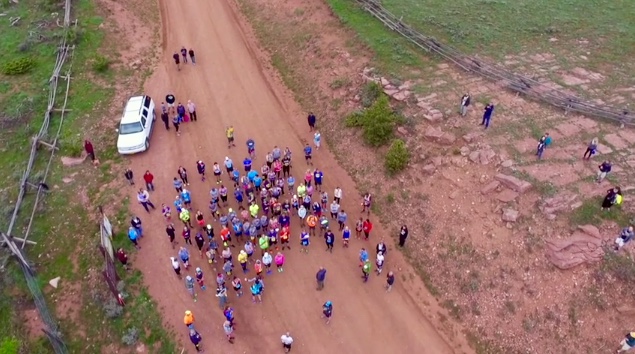
"There's been a shooting. They won't let you run through the crime scene, so we have to modify the course." With a start like that, we should have known it would be an extraordinary day. The announcement from the race director quieted the small gathering of runners. We were waiting at the top of a hill on the dirt road behind the Abraham Lincoln Memorial Monument near Laramie, Wyoming to start the Wyoming Marathon Races half marathon, marathon, and 50k. The race director went on to explain that instead of running the intended out-and-back course, the marathon and 50k runners would repeat the half marathon course until the prescribed distance was met.
This event was low-key to say the least.
I took a bunch of still pictures from the drone footage posted on the race's Facebook page. Here's the small group of runners waiting to start.
The crowd gracefully digested this information and one of the runners led the gathering in singing the national anthem. Moments later, the pack was off and running down the road. I kissed Trent and reminded him to be careful: he planned to spend the morning fishing while I ran. "You be careful!" he laughed, and I ran down the hill to start my 50k day.

The plan I'm following for the Silver Rush 50 includes a couple of "training races" along the way and this weekend the plan required a 50k race. Laramie is only a couple of hours' drive from Denver, so this race seemed like a cool way to get the training done and to see a little bit more of our world. The race is at elevation (it starts just below 9000 feet), and although it isn't on trails, it is on mostly dirt roads so it seemed like a good pick.

Two things about the race made me nervous - surprisingly the altitude wasn't one of them! Because of the small field of runners, there was a real danger of coming in last place. And, the first 5 miles of the course was straight down a hill, which meant that the last 5 miles back up the hill would be tough. I had these things in mind as I trotted slowly down the hill: in the last few months of longer-distance trail running, I've become acutely aware of how easily you can ruin your day by running too fast in the first few miles.

A drone pic from the first few miles.
As I ran down the hill, I considered what it was going to take to run back up and down it 3 more times. But after about 45 minutes had passed, a pickup truck drove along beside us and the driver shouted out to the runners that the crime scene was cleaned up and we could resume running the original course. Hooray!

The sun shone brightly as we approached the half marathon turnaround point. As the half marathon participants turned around, the pack of runners thinned out and I continued happily along the dirt road, running mostly by myself with just 4 or 5 other people around me. I gazed at the gorgeous mountain scenery and felt joyful about the light wind that ruffled my clothes. Off-road running is amazing! The races are so much smaller and you spend time by yourself, just enjoying what's around you. Why didn't I start this years ago?!
Drone shot of the gorgeous scenery of Medicine Bow National Forest.
There's a short segment of the course that goes along the access road of the highway, but apart from that the entire course is on gravel roads. On the way out the course rolls mostly downhill, and I spent miles 8-15 marveling at how strong I felt. My goal was to spend less than 7 hours doing the race, and that seemed very possible when I hit the turnaround at 15.5 miles. Then I realized that I'd basically been running downhill for the last few miles and it was time to climb back up. That's why everyone who was coming back the other way was walking. Yikes. Also, it was getting hot and there was no shade on the exposed dirt road. For the first time ever, I fought the nausea that comes with pushing the pace too hard at altitude in warmer conditions. Although my pace already felt painfully slow, I slowed down. Ugh. This is so uncomfortable! Why did I decide to do all of these ultra-distance races this year?!

As usual, one of my favorite things was meeting all the people out on the course. I'd noticed a guy in a Kerrville Triathlon Festival hat at the start, and as he ran towards me from the marathon turnaround point as I was still on my way out, I stopped him and asked if he was from Texas. Ken from Austin and I became friends immediately - what a small world! At the marathon turnaround point, there was an aid station where I filled up my water bottles and grabbed my first cup of delicious Coke. The volunteer there was a Laramie local who's running a couple of big ultras this year. Yes, I stood there and chatted with him about it as we leisurely filled bottles. I guess at some point I'll have more urgency in racing these longer distances, but that was not the case last Sunday.

As I shuffled back along the out-and-back course, I spent miles 16-20 feeling pretty crappy. My legs were starting to hurt, I was feeling dehydrated even though I thought I was drinking plenty, and I was tired of eating Gu. But then, along with a little bit of downhill on the course, my mood turned around, and I tirelessly trotted back towards the finish line, marveling again at the scenery. I was alone on the course but aware that there was a runner slightly ahead of me and another one slightly behind me, both just out of my view. I saw a line of dark clouds slowly approaching and felt smug about having a raincoat in my backpack. I am sooooo prepared for mountain running. The shifts in mood that you experience in a long day of racing feel more intense to me in trail running than in triathlon. I'm not sure why I felt so much better at that point, but I welcomed the happy mood that replaced how I was feeling just 30 minutes earlier.

Approaching the last five miles back up the hill, I willed myself to run when possible and to walk as quickly as I could when running was too difficult. With about 3 miles to go, I saw Trent driving down the hill towards me! He offered some quick encouragement and then told me that he'd see me at the finish line. I complained that I might not make my goal time. The only thing on my mind was getting to the line before my watch hit 7 hours.

Then, the storm that had slowly been coming towards us for the last 2 hours made its dramatic entrance with a loud clap of thunder. I hurried to put on my super-light amazing new trail running raincoat and congratulated myself again on carrying it. The rain started to come down. I briefly considered that lightning was dangerous, but kept on running. Then, the rain started to fall harder. Wait, that isn't rain. It's hail! I started laughing at how ridiculous this last couple of miles was shaping up to be.

With one mile left, the pea-sized hail became heavier and stung my unprotected legs. The volunteer from the aid station that I'd chatted with earlier came driving down the hill from the finish. He opened the passenger door and told me that if I wanted a ride back I'd still be considered a finisher, but I was free to wait for the hail to stop if I wanted to make sure I ran the full course. I also had the option to continue running up the hill in the hail. I climbed into his car and decided to wait for the hail to slow, but then he started to drive down the hill, away from the finish line! He needed to check on the runners behind me. At that moment, I saw Trent driving back down the road and we signaled to him to stop. I jumped out of the volunteer's car and into Trent's.

As I sat in the passenger seat laughing, catching my breath, Trent handed me his thick Gore Tex fishing raincoat. "Take this," he said, "it's strong and will protect you. Finish the last mile!" Neither of us considered driving to the finish line to be an option. I jumped out of the car, we both laughed, and I continued up the hill into the hail. The whole situation seemed hilarious and ridiculous. Then the hail got bigger. A lot bigger. I watched the large pieces fall and shatter in front of me on the road. Then one hit me on the head. Another one hit me hard on the shoulder. For the first time, I looked around for shelter, and ended up crouching under a tree to protect myself from the larger pieces of hail.
Running in Trent's fishing jacket. Soon the road would be covered in white hailstones and looked like it had been snowing.
Moments later, Ken from Texas came driving down the hill in his rental. "Kris from Texas!" he yelled, "take shelter in my car!" I leaped gratefully into the car. The hail was coming down like crazy now. Ken found a little tree to protect the car and we chatted as the loud hail bounced off the windows. He said we could wait as long as necessary, but that with only a mile left, I couldn't not finish the race. I agreed. I texted Trent to tell him my plan.

After about 10 minutes passed, the hail lightened again and Ken drove me back up to the main road. He wished me well and I started my journey once again. At this point, the 7 hour mark was long gone. Although the hailstones were smaller, they still stung my bare legs as they fell, and I could see small welts starting to form. This is stupid. Not the kind of stupid where you wonder in a state of exhaustion why you picked endurance racing as your hobby. It's like stupid, stupid. 
"It's all fun and games until God starts throwing golf balls at you." - Trent Wunstel
The hail got bigger again and there were no trees to hide under. As another large hailstone hit me hard on the shoulder, for the first time ever in 10 years of endurance racing adventures I thought to myself that I could actually die from this. The next car that came along offered me a ride, and I unquestioningly dove into their back seat with a growling dog, grateful to escape the painful hail. They drove me to the finish line where Trent waited in the car.

Trent pulled up next to the car in which the race director waited, and I told him through a partially opened window that I was safe and off the course. He said, "oh you earned the belt buckle." He handed it through the window to me, along with a hailstone that he picked up off the ground. "A souvenir of Wyoming," he said, laughing.
Earned it!
Trent and I laughed all the way back to Denver in our car that is now coated in hail damage. What a ridiculous day! In my mind this was technically a DNF, but I'm listed as the last finisher in the results online. A last-place finish - that's a first. But I also ran as fast as I could up a hill at the end of an ultrarun to try to escape the hail, so now I know I can do that. That's a win!

The following day, I ran the Bolder Boulder 10k as my "second long run" of the weekend. I've been doing these back-to-back long runs for a couple of months now, and every time I do it, it feels better. I'm astonished that I ran 60k in one weekend. The way the body adapts to training is incredible! After this, I feel much more confident about the big races in Leadville that I have coming up in the next month and a half. Hopefully they'll be hail-free.

All joking aside, this was a really cool, well organized event. The volunteers were wonderful and the race is perfect for someone trying their first ultra at a little bit of altitude with terrain that isn't even a little bit technical. The drive to Laramie was gorgeous and the town itself was fun to visit. Hail or no hail, I don't think this will be my last time racing the Wyoming Marathon Races! A quick thank you to our wonderful friend Doug who recommended it, although we certainly gave him a hard time about the weather and the car for the couple of days after the race.

I want to say a big thank you to Doug, Whiting, and Maggie for providing cheers, inspiration, and encouragement through texts to Trent throughout the day; I could certainly feel the love. Thank you to everyone who followed and commented on Facebook. And thanks as always for reading! See you out on the trails.

Bolder Boulder was my friend Laura's first race and first time ever running 10k. Here we are at the start line. She crushed it and I was so proud to get to be a part of her first road-running experience!
Another Bolder Boulder pic - I loved running and celebrating with teammates in our gorgeous Big Sexy Racing Ownway Apparel kits!

Sunday, October 22, 2017

Ultra Baby! Bear Chase 50k Race Report 2017


After pacing our friend Doug at the Leadville 100 in August, it was inevitable that I'd be inspired to try an ultramarathon. Of course my first wouldn't be a 100 mile race, but I wanted to know what it felt like to run more than 26.2 miles at one time, on trails. Following Doug's advice, I signed up for the Bear Chase 50K, which would take place approximately 6 weeks after inspiration struck at Leadville.

I was concerned that there wouldn't be enough time for a real build for this 31-mile trail race. I haven't been doing that much running this year anyway; I was barely trained to run the 13.1 miles at the end of Boulder 70.3 in August. But a trail race is very different from a road race, and I'd learned in Leadville that there would be a fair amount of hiking instead of running. Without allowing myself to think too carefully about it, I signed up for the race, and the wave of fear-induced nausea that came over me when I pressed the "submit" button was wonderful.

Besides the lack of time to prepare, I had another potential complication going into this first ultra: I would be self-coached for the first time in 7 years. I could write an entire post about the agony of that decision, but the short story is that I couldn't justify the financial cost of having a coach against what I was willing to put into training. I loved having a coach, and it was a fairly large sacrifice to go off on my own. Two months later, I do ultimately feel like it was the best decision for me at the time.

After some online research and some great tips and advice from my lovely friend and original coach(ie) Dawn Elder, I put together a plan for this trail race. It wasn't particularly sophisticated: training consisted of running and swimming a lot, and putting my bike away for a few weeks (our relationship needed a break anyway).

I felt super cool buying all the important necessary gear: a new pair of trail shoes, a hydration backpack, and a hat with a picture of a runner on it. Trent joked that I was wasting no time "rebranding" myself as an ultrarunner. I have to say that it felt very cool to be doing something different.
Super cool, super necessary gear.
The great thing about the race that I picked is that it was right next our apartment. That meant that I got to practice on the course nearly every weekend. Whiting and I had signed up for the race together, and we ran one unlucky training run on the course where she literally broke her foot. I felt terrible for her having to end her season that way, and I wasn't thrilled about continuing to train by myself, but I was committed.

Whiting standing in one of the water crossings on one of our training runs.
It takes a lot longer to run on trails with elevation gain than it does to run on pavement. My 17, 19, and 20-mile training runs were taking upwards of 4 hours. But, in a very short amount of time, I developed an intense love for running on trails. It's the kind of running where you don't have to be distracted by music. You somehow get connected with the air and sky and the ground beneath you and although it hurts to run for several hours at a time, it feels completely different from training to run a particular pace for a road race. It's somehow just completely freeing. Maybe because as a beginner, there are no expectations (from myself or others) of time or pace. I loved training for this race.

Race day itself was a total celebration. The course was 1 small loop and 2 big loops around the Bear Creek Lake park. It was marked by little ribbons tied to trees. There were 7 knee-deep water crossings and 3 hikes up a hill labeled Mt. Carbon, so I am going to say that I ran up a mountain 3 times during this race. It was such a small event with barely any fanfare and just over 100 participants. Basically, it was totally the opposite of an Ironman. I loved it.

I spent the first 20 miles smiling and giggling and apparently breaking into song and dance and jazz hands every time I saw someone with a camera. After I began the 3rd loop, with 11 miles left, the wheels began to come off, and there was plenty of walking from that point on. At the 26 mile mark, I marveled to myself that every step after this would be further than I'd ever ran before. And then the guy in front of me yelled "rattlesnake" and 3 of us had to jump over a terrifying snake, which at that point in the day, took quite a great deal of energy!

Jazz hands

More jazz hands
Doug was volunteering to direct traffic about halfway through the big loop. Seeing him was amazing and I cheerfully thanked him for the inspiration. Doug and Whiting's kids were volunteering at an aid station just down the hill, and it was so fun to see familiar happy faces three times on the course. I finished the race with a cheering section led by Trent, Whiting, and Annette, whose husband had also raced.

My race took seven hours. I have never run for such a long time in my life. After talking with friends post-race, I realized that starting my triathlon journey as a fairly slow participant actually gave me a huge mental advantage as a beginner at this event. There was a ton of suffering out there on the last loop of the run, but mine was minimal compared to that of other participants. I know what it's like to suffer through a 7 hour half ironman, and a 16 hour ironman race. Other folks making the leap to "ultramarathon" likely do it after a few successful marathons, and running 26.2 fast miles on a road is very different from running 31 miles on trails.

I wasn't even close to fast; in fact, of 133 entrants, I finished in 100th place, near the bottom of my age group. None of that mattered. I was so excited to finish my first ultra and to be able to say with pride, "I am an ultrarunner!"

Although I know my true love is triathlon, running is always like coming home. Trail running is quickly becoming one of my favorite things to do. I think back to some camp experiences where I described trail running as "the seventh circle of hell," and it makes me laugh to think about how different my mindset is now.

As always there is a common denominator in endurance racing of any kind. I love that all of it has the same kind of lesson for me - what can I do? How far can I push myself out of my comfort zone? I think the answer is "pretty far," and I'm fairly certain I haven't even scratched the surface yet. I say it every year around this time, and I'm saying it again: I can't wait to see what's next.